
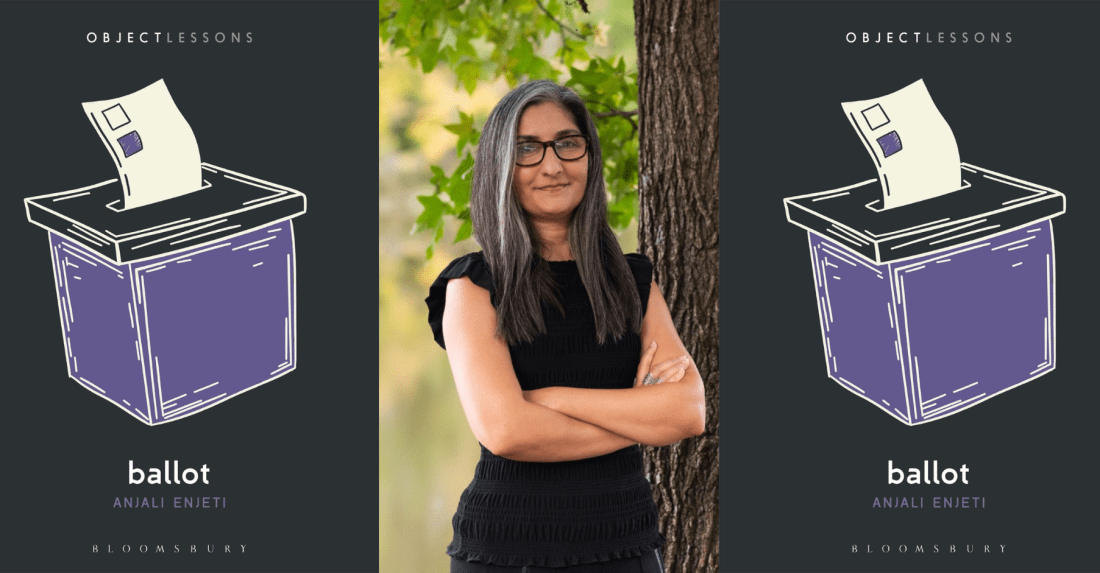
Everything about Anjali Enjeti’s newest book, Ballot, is deceptively small at first glance. Part of Bloomsbury’s Object Lessons series, Ballot is compactly sized, standing at 6.45 inches tall and clocking in at 136 pages. But like Enjeti’s previous books – the novel The Parted Earth and her essay collection Southbound – Ballot invites the reader to go deep with heartfelt focus and layers of narrative. Her third book tells the history of voting and voting rights from Enjeti’s perspective as a Georgia voter, activist, poll worker and former attorney. For readers who are curious about what the future of democracy looks like, Enjeti uses the book to explore and answer a core question, How did America end up here, and how will we evolve?
I caught up with Enjeti over virtual coffee for a conversation about the book, her research and drafting processes, and what hope we can hold onto as we move forward together as a society.
NOTE: This interview has been edited and condensed for length.
Let’s talk about the moment you knew you wanted to write this book. Bloomsbury’s Object Lessons series describes itself as “a series about the hidden lives of ordinary things.” You open the book with your first experience of a mock election when you’re seven years old, and then chart your growing curiosity, dedication and voting advocacy through your young adult years into adulthood. Was this opening image – the chewed No. 2 pencil, the mock ballot – where you organically landed to open the book, or was there another scene or revelation that was the first kernel?
I’ll start by saying that voting has always been an emotional touchstone for me.
I did not grow up in a family that was political. I did not grow up with parents who talked about voting.
The second grade mock election I write about in the book, which happened in 1980, when Reagan was challenging Jimmy Carter… that was my father’s first election to vote in. He was an immigrant from India in 1971, and he had finally become a citizen, so he was voting for the first time.
This mock election, where I ripped out a piece of paper and cast my ballot for Reagan, because I’d heard he was an actor, was also my first “political” experience. Other than watching the nightly news with my parents and watching them read the newspaper, we did not talk politics in our home. But when I later found out my parents voted for Carter, I remember the regret I experienced as a small child: “Oh, I should have thought about this more.”
Voting made me feel so powerful at age seven. I’ve never lost that feeling. I’m 52 years old, and I still feel such a tremendous emotional weight when I think about voting, when I think about casting my ballot.
There were obviously a few more recent things that eventually led me to write this book. The bulk of it happened after I moved to the South. The kernel, the seed of the idea for the book, really came after 2020 when Trump lost and he targeted battleground states by pressuring them to enact legislation and policies that would make it far more difficult to vote.
One of the hardest states he came out against was Georgia, specifically Fulton County, where I’m a voter and poll worker. He and his cronies terrorized two election workers, Ruby Freeman and Shaye Moss, and filed dozens of lawsuits across the country. Many, but not all, were thrown out.
This pressure from Trump led to these battleground states and additional red states to pass voter restriction legislation. And this is still happening. What we’re continuing to witness is essentially an electoral insurrection.
When Georgia passed SB202, a catastrophic voter suppression law, that’s when I thought, “Okay, Trump’s 2020 loss is a catastrophic turning point, and this is what I really want to focus on, and this is why I need to write this book.”
The layered historical evolution of voting rights is just as deep as it is expansive. The Object Lessons series is known for its short, tight tomes, which becomes a creative boundary for a topic this massive. I’m curious how you approached structuring the book and if the structure changed at all during the process.
I had an idea for the structure of the book that completely fell apart because of the kind of election year we had in 2024. Originally, I was not going to say much about the 2024 election. I was going to mainly make this about post-2020 election laws and policies that impacted the voter.
Then in July, when it was very late in the election cycle, Joe Biden stepped down and Harris became the new Democratic nominee.
It was wild. There I was, trying to write this book one way, when this 2024 presidential election was unfolding in an unprecedented way. So a significant chunk of this book ended up being about this election, how we got here, and how we could figure out how to move forward.
“Two steps forward, one step back” accurately sums up how it feels to vote in today’s climate. Let’s talk about the Supreme Court’s decision in 2013 to get rid of pre-clearance for the Voting Rights Act because since then voter ID laws have been added, which affect minority groups who were once protected by VRA: Native American, Black, Hispanic and AAPI communities. Add to this proof of citizenship requirements and felony disenfranchisement. Not coincidentally, these are folks who often have to balance a lot of obligations just to get through the day – there is a shortage of access to educate and stay up to date on these things. What are accessible resources to understand the most current state of voting rights? And does focusing on smaller but changemaking local elections seem like a good place to start improving access to voting?
Many civil rights organizations in the U.S. do a very good job with voter education. We have Fair Fight. We have Fair Vote. We have the League of Women Voters. We have the NAACP. But still, we have to be very proactive to be informed voters.
Voter education is still a big barrier. I know a lot of candidates try to fill this gap, right? They go out to tell people to vote, and try to go through the steps: Do you know how to find your precinct? Do you know when early voting starts? Do you know when your precinct opens and when it closes? Do you have a way to get there? What’s your plan to vote?
Everybody needs to have a plan, which means you have plan A to vote, and then if that doesn’t work out, you have plan B, and then you have plan C. Plan A might be going to vote after work. Well, traffic is really bad. Your car breaks down. You can’t get to the polls by the time they close at 7 p.m. Then what’s the next plan? Getting voters to create a tangible voting plan is crucial.
Republicans change election rules so frequently, on purpose, to confuse voters. Democrats need to try to better educate voters about what these changes are. What’s more, local elections oftentimes fly under the radar. Many voters still believe the most crucial races are for the presidency, the U.S. Senate, and the House of Representatives, when in reality, local elected officials do the heavy lifting of democracy and can also help shield us from fascism.
Many voters don’t even know about their state elections, about the fact that they have a state senator or have a state representative. Raising awareness about elections and good candidates is probably our best defense.
You have voted in every major election since 1992 in four different states as well as countless regional, state and municipal elections. You say it “always felt like my calling” but also that “elections do not deliver liberation.” They exist in the context of the U.S. empire and can operate as a “vital stopgap.” You quote John Lewis who said, “The vote is the most powerful nonviolent change agent you have in a democratic society.” If the right to vote goes away or if states are even more strictly gerrymandered during this current administration, does democracy die? What are your additional thoughts for your suggested actions “beyond the ballot,” such as contacting your elected officials, mutual aid, organized protests, and boycotts?
I was really thankful to be able to write about voting and voting rights as a red state voter. I think we red state voters are grossly misunderstood. Voters in blue states do not understand the kinds of barriers we face. There are some wonderful books that have been written by authors in red states. My favorite one is Dr. Carol Anderson’s One Person No Vote. It’s an outstanding book on voting and voting rights.
But a lot of books are written by people in blue states who do not have the lived experience of voter suppression that red state voters do. And quite frankly, they don’t experience the stakes in elections to the same degree.
There are few things that give me hope, though…
First of all, we have outstanding people in Congress who give a damn. People like Ilhan Omar, Summer Lee, Rashida Tlaib, Delia Ramirez, Ayanna Pressley. They are fighting hard and doing the right thing. Mayor Zohran Mamdani’s primary election win over Andrew Cuomo, was also a big moral boost for me. In fact, we’ve had quite a few progressives win primaries or come very close to winning primaries since then. This system does not work well for most Americans, but it can.
What eventually turned the table for me was watching the incredible amount of mutual aid that has been delivered since Trump was elected again. Watching communities come together, you know, like after the destruction in the wake of Hurricane Helene in North Carolina. This is proof that regardless of electoral politics, we can shape the society that we want to shape.
Congressman John Lewis, whose spirit is still with us, knew this fact. He knew this reality that when a government doesn’t step up to do its job, we have each other.
Minnesota residents literally replaced the duties of their government during a months-long ICE occupation. Community members provided rental assistance and food and health care and guarding preschools and elementary schools and high schools and giving people rides and meeting people released at 1 a.m. from ICE custody and provided blankets and food and cell phones to call all their loved ones.
We have an innate power within ourselves and within our communities to deliver care to one another. And ultimately, we can step in when the government doesn’t.
There’s still hope within the system and there is still absolutely hope outside of the system.
Let’s talk about research for narrative nonfiction. What is your approach to research when writing? Is it research first, structure second or vice versa? And do you have organization advice for writers who are wading through a lot of research in their own projects?
It’s very hard for me to not get bogged down by research. I have this ability to hyper-focus, which actually makes it really hard for me to actually write because I go down every rabbit hole. And then I realize I’ve spent two weeks not penning a single word.
There were a few things I thought about when it came to research. One: this book is a pretty leftist take on elections and voting. My politics do not neatly align with the Democratic Party. I’ve been active in electoral politics since 2017. But before that, my activism was very much not a part of the two-party system.
Two: we live in an age of massive disinformation and misinformation. So I wanted to provide evidence for what some might call radical views. This is part of the reason why I have around 700 endnotes. It’s really an obnoxious amount of endnotes, and I totally own this.
I did not want readers who disagree with my perspective on voting and elections to dismiss my views. I really did my best to use hearty, reliable sources to cite them.
When you write creative nonfiction, you have to be prepared for critics who will say that your arguments are not really based on the evidence. It’s also really important for nonfiction writers to prove to themselves that their arguments carry weight.
At 136 pages (not counting source citations), this book is a masterclass in editing and revisions. Do you have any tips for editing or revisions for writers (of fiction or nonfiction)?
This tip will be helpful for some writers and be disastrous for others: I make myself get to a certain point in the writing before I allow myself to do revisions.
For example, I’ll say to myself: I am going to write this chapter on gerrymandering. So I’m writing and writing and writing and writing. Then after a few days of writing, I’ll say, Okay I’m going to go back and read it. But the thing is, I usually haven’t written enough in my first or second or even third draft to know what needs to be revised.
I sometimes think I know what needs to be revised or think I know what the structure needs to be. But by starting the revision process too early, I do not let myself get into the weeds enough. It takes me a very long time to know what a chapter or section is about. I end up just having very canned passages that look pretty, that maybe even sound pretty, but have no real substance.
For me, writing is really about withholding revision until I finally get it, until I finally understand the emotional guts of what I’m trying to say.
You’ve moved effortlessly between fiction and nonfiction. What’s next for you?
I don’t have a plethora of ideas. I have things that I kind of loosely work on, but then they become dormant for three, four, five years, and I forget about them.
So I don’t really know what’s next. This project idea came to me so quickly and so suddenly. I was literally having dinner with a friend of mine who was another Object Lessons author, Simona Supacar. She wrote an outstanding book, Stock Photo, which was published in the same month as Ballot. The book is brilliant. Over dinner, she was talking about the process behind Stock Photo and that was when I suddenly got the idea for Ballot.
I mainly just have to be patient and hang out, to see if there’s something next.
NONFICTION
Ballot
By Anjali Enjeti
Bloomsbury
Published February 5, 2026


